
For high-earning retirees in Southwest Michigan, Medicare is not a fixed cost; it’s a variable expense tied directly to your tax return. If your income exceeds specific thresholds, you will trigger IRMAA (Income-Related Monthly Adjustment Amount)—a series of surcharges that can increase your Medicare premiums by more than 300%.
The 2026 IRMAA “Cliff” Tables
Medicare uses a two-year lookback to set your premiums. For 2026, the Social Security Administration reviews your 2024 tax return. Unlike standard tax brackets, IRMAA is a “cliff.” If your income is even $1 over a threshold, you pay the full surcharge for the entire year.
Understanding the 2026 IRMAA “Cliff” System
The federal government evaluates your wealth using a fixed two-year lookback period. To establish your 2026 Medicare premiums, the Social Security Administration reviews your reported income from your 2024 federal tax returns.
Unlike standard federal income tax brackets, which are progressive, IRMAA operates on a strict cliff effect. Stepping over a threshold boundary by even one dollar forces you to pay the maximum surcharge for that entire tier for the full calendar year across both Medicare Part B and Part D.
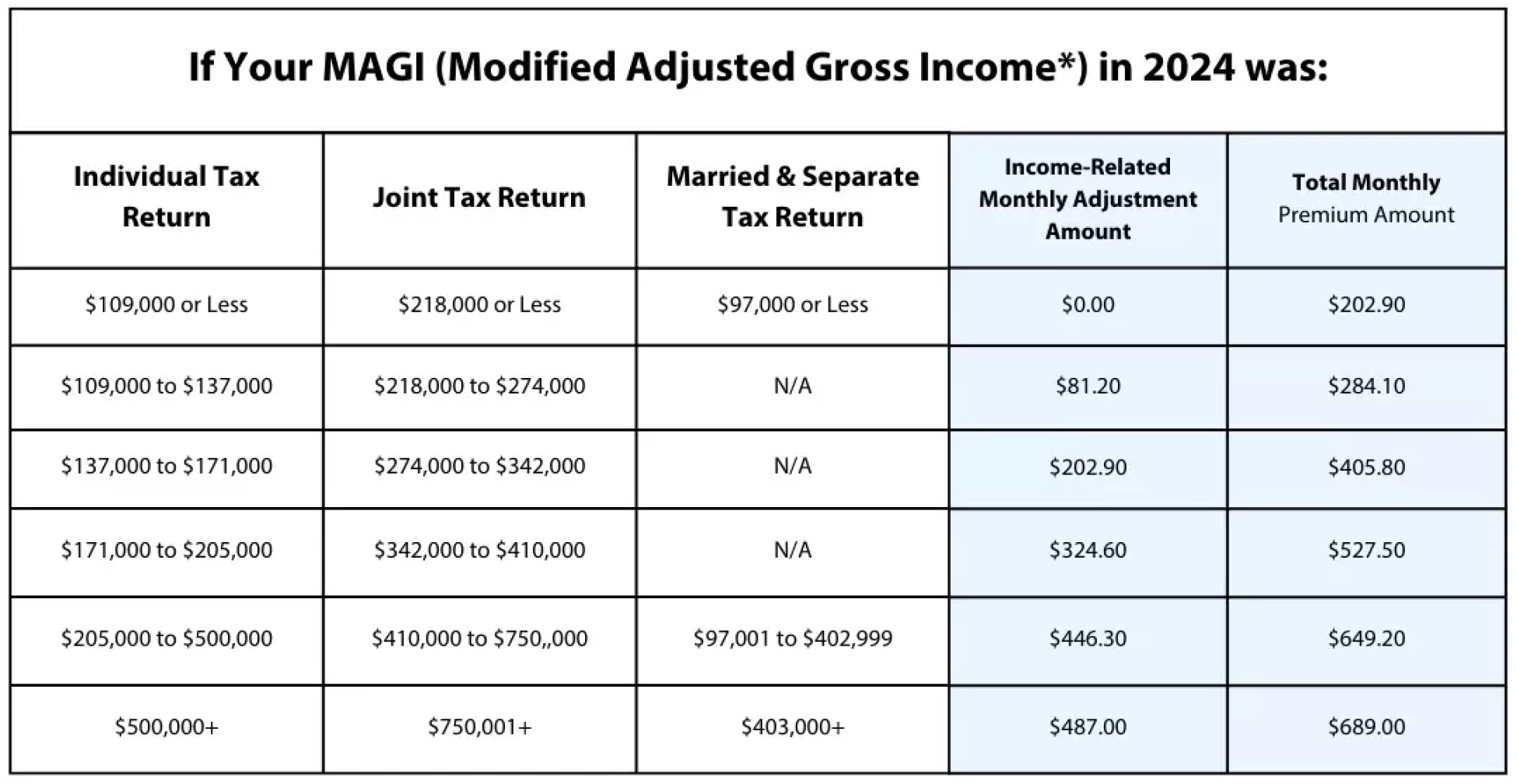
Based on official 2024 tax filings, the structural baseline tiers for 2026 are broken down below:
The IRMAA Surcharge Table
- Standard Base Tier: Applies if your 2024 Modified Adjusted Gross Income (MAGI) is $109,000 or less for single filers or $218,000 or less for joint filers. The baseline monthly Part B premium is $202.90 with a $0.00 Part D surcharge, resulting in a total annual couple cost of $4,870.
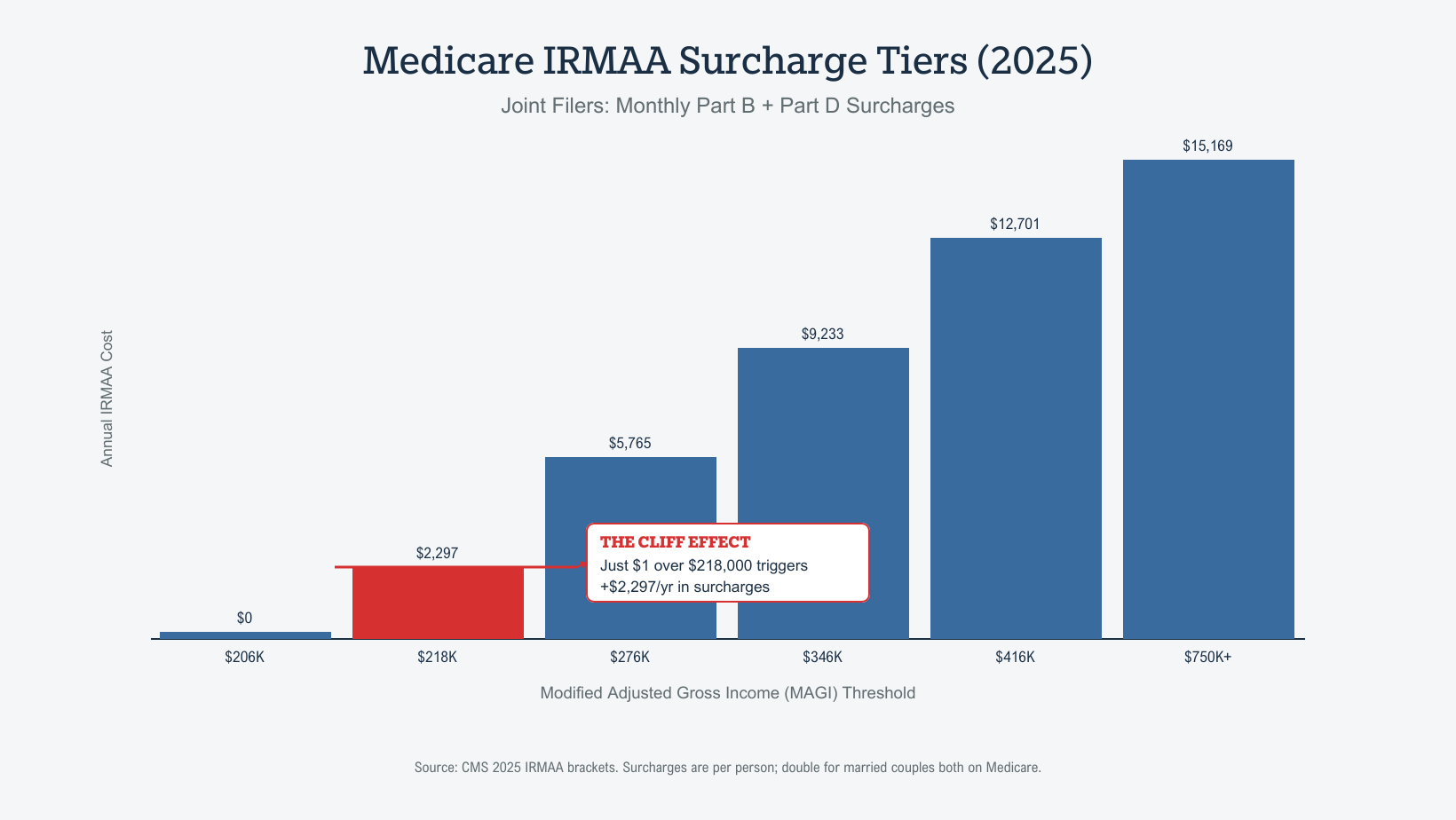
- Tier 1 Bracket: Applies for single incomes between $109,001 – $137,000 and joint incomes between $218,001 – $274,000. The monthly Part B premium rises to $284.10 with a $14.50 Part D surcharge, bringing the total annual couple cost to $7,167. Crossing this threshold by pocket change instantly adds a $2,297 annual surcharge penalty per couple.
- Tier 2 Bracket: Applies for single incomes between $137,001 – $171,000 and joint incomes between $274,001 – $342,000. The monthly Part B premium is $405.80 with a $37.50 Part D surcharge, bringing the total annual couple cost to $10,642.
- Tier 3 Bracket: Applies for single incomes between $171,001 – $205,000 and joint incomes between $342,001 – $410,000. The monthly Part B premium is $527.50 with a $60.40 Part D surcharge, bringing the total annual couple cost to $14,110.
- Tier 4 Bracket: Applies for single incomes between $205,001 – $499,999 and joint incomes between $410,001 – $749,999. The monthly Part B premium is $649.20 with a $83.30 Part D surcharge, bringing the total annual couple cost to $17,580.
- Maximum Surcharge Tier: Applies if single income is $500,000 or more or joint income is $750,000 or more. The monthly Part B premium caps at $689.90 with a $91.00 Part D surcharge, bringing the maximum total annual couple cost to $18,742.
High-Net-Worth Portfolio Vulnerabilities
Protecting your retirement nest egg from accidental premium spikes means monitoring specific income components that traditional tax software often overlooks.
Strategy 1: The QCD—Your Tool Against the “Cliff”
If you are age 70½ or older, a Qualified Charitable Distribution (QCD) is one of the most effective tools available to keep your income safely below an IRMAA threshold. Through this strategy, you can direct up to $111,000 per year from your Traditional IRA directly to a qualified 501(c)(3) charity. Unlike a standard charitable deduction, which only offsets taxable income after your adjusted gross income is calculated, a QCD is completely excluded from your income at the source.
For a couple in Battle Creek with a total income of $220,000, executing a $5,000 QCD drops their reported MAGI below the $218,000 cliff. This single maneuver supports a local cause while instantly saving the household $2,297 in accidental Medicare penalties.
Strategy 2: Unmasking the Municipal Bond Illusion
Many affluent investors rely heavily on municipal bonds to generate tax-free income. While this interest is completely exempt from traditional federal income taxes, it is not exempt under Medicare rules. The federal government specifically adds your tax-exempt interest (reported on Line 2a of your Form 1040) back into the calculation used to determine your MAGI.
If you have $210,000 in standard taxable income and $15,000 in municipal bond interest, your tax return appears safe from high tax brackets. However, Medicare calculates your MAGI as $225,000, pushing you over the Tier 1 boundary.
When rebalancing your assets, we must evaluate the “all-in” cost, as an uncoordinated municipal bond yield can be entirely canceled out by the healthcare surcharge it triggers.
The Fiduciary Difference: The 24-Month Mirror
Because of the two-year lookback system, the decisions you make at age 63 are already actively determining your baseline Medicare costs at age 65. If you are 63 or older, you are officially operating inside the Medicare Lookback Zone.
“Most people view tax bracket planning and health insurance as entirely separate goals, but your tax return is effectively a Medicare pricing sheet,” says Justin Henrich, Medicare, Insurance, & Financial Advisor. “When we design a wealth strategy, we use a 24-month mirror. We synchronize your portfolio distributions, Roth conversions, and tax-loss harvesting in real time so that maximizing your investment returns this year doesn’t trigger a massive, retroactive premium penalty down the road.”
As your local fiduciary, I look at your complete financial picture to coordinate three moving pieces:
- Sizing Roth Conversions: We model your Roth conversions to maximize your long-term tax brackets without accidentally pushing your current MAGI over an IRMAA cliff.
- December Tax-Loss Harvesting: We look for opportunities to lock in strategic investment losses before the end of the year, artificially bringing your MAGI back under a surcharge line.
- Bypassing the Lookback with Form SSA-44: If your recent high income was driven by an active career that has since ended, you are not trapped by past returns. If your household income drops due to a qualifying life-changing event—such as full retirement or a reduction in corporate working hours—we can file an appeal using Form SSA-44 to adjust your premiums to match your current retirement income structure immediately.
Strategy 1: The QCD—Your Secret Weapon Against the “Cliff”
If you are age 70½ or older, a Qualified Charitable Distribution (QCD) is the most effective tool to keep your income below an IRMAA threshold.
- How it works: You direct up to $111,000 per year (2026 limit) from your Traditional IRA directly to a qualified 501(c)(3) charity.
- The IRMAA Win: Unlike a standard charitable deduction, a QCD is excluded from your income entirely. It lowers your Adjusted Gross Income (AGI) at the source.
For a couple in Battle Creek with a $220,000 income, a $5,000 QCD drops them below the $218,000 “cliff,” saving them $2,297 in surcharges while supporting their favorite local cause.
Strategy 2: The “Hidden” Trigger—Municipal Bond Interest
Many high-net-worth investors rely on municipal bonds for “tax-free” income. While this interest is free from federal income tax, it is NOT free from Medicare.
Medicare’s version of MAGI specifically adds back your tax-exempt interest (Line 2a on your Form 1040). In “Main Street Math” terms, MAGI is the number the government uses to decide if you are a “high-income” retiree.
- The Trap: You might have $210,000 in taxable income and $15,000 in muni-bond interest. On your tax return, you appear safe. However, for Medicare, your MAGI is $225,000, triggering the first tier of surcharges.
When rebalancing your portfolio, we look at the “all-in” cost. Sometimes, the yield from a municipal bond is negated by the Medicare surcharge it triggers.
The Fiduciary Difference: The 24-Month Mirror
Because of the two-year lookback, the decisions you make at age 63 are already determining your Medicare costs at age 65.
- Coordinate Roth Conversions: We size your conversions to fill tax brackets without accidentally crossing an IRMAA cliff.
- Tax-Loss Harvesting: We use strategic losses to bring your MAGI back under a surcharge line in December.
- The Life-Changing Event Appeal: If you retired recently and your income dropped, we can help you file Form SSA-44 to appeal these surcharges immediately.
Best Practice Tip: Always coordinate your Roth conversions with your Medicare lookback years. If you are 63 or older, you are officially in the “Medicare Lookback Zone.” Every dollar you move now is being “watched” by Social Security for your future premiums. Your CPA and your Medicare agent often work in silos. A fiduciary bridges that gap, ensuring a “good tax move” doesn’t become an “expensive Medicare mistake.”
Call Justin at (269) 323-7964 to schedule a “Modified Adjusted Gross Income Stress Test” and ensure your retirement income strategy is fully optimized for 2026.
This blog is created and authored by Chuck Henrich (Content Creator) and is published and provided for informational and entertainment purposes only. The information in the Blog constitutes the Content Creators own opinions and it should not be regarded as a description of services provided by Southwest Michigan Financial, LLC. The opinions expressed in the Blog are for general informational purposes only and are not intended to provide specific advice or recommendations for any individual or on any specific security or investment product. It is only intended to provide education about the financial industry. The views reflected in the commentary are subject to change at any time without notice.
Nothing on this Blog constitutes investment advice, performance data or any recommendation that any security, portfolio of securities, investment product, transaction or investment strategy is suitable for any specific person. The Content Creator and Southwest Michigan Financial, LLC assumes no responsibility or liability for any consequences resulting directly or indirectly for any action or inaction you take based on or made in reliance of the information, services or materials provided within this blog.