The Transition Risk
Continuing to work past 65 requires strict coordination to avoid permanent late penalties. If your employer has fewer than 20 employees, Medicare is primary, meaning you must sign up at 65 regardless of your job.


Staying in the workforce past age 65 is a common move for modern professionals. However, transitioning into retirement requires careful coordination between your employer’s human resources department and your financial planning. If you do not execute this transition correctly, you risk triggering lifelong premium penalties or major tax surprises.

If you choose to delay Medicare because you are still working, your timeline relies on your “Special Enrollment Period” (SEP). Keep these three operational rules in mind:

When you transition off your employer’s plan, you also must choose how to structure your health coverage. This decision heavily impacts your premium budget and your local medical access:
Healthcare costs do not exist in a vacuum; your investment and tax decisions directly dictate your monthly insurance premiums. If your income exceeds specific limits, you face the Income-Related Monthly Adjustment Amount (IRMAA). Or more simply put, “The more you earn, the more you pay for the exact same Medicare coverage as everyone else.”
If your income exceeds specific limits, you face the Income-Related Monthly Adjustment Amount (IRMAA). This is a mandatory surcharge added directly to your standard Medicare Part B and Part D premiums. Higher earnings mean you pay substantially more for the exact same Medicare coverage as everyone else. Here are the details:
Justin Henrich, Medicare, Insurance, & Financial Advisor
“Essentially, IRMAA is a premium surcharge added directly to your standard Medicare Part B and Part D plans if your income exceeds certain thresholds,” explains Justin Henrich, Medicare, Insurance, & Financial Advisor. “Failing to connect health and wealth exposes high earners to these costs because healthcare expenses do not exist in a vacuum—your investment and tax decisions directly dictate your monthly premiums. The more you earn, the more you pay for the exact same Medicare coverage as everyone else.”
A Roth conversion is a great fiduciary strategy to reduce long-term taxes by moving money from a Traditional IRA to a Roth IRA. However, the IRS treats that converted amount as taxable income in the year you move it. Because of the two-year lookback, a large Roth conversion executed at age 63 or 64 will directly dictate your premiums the exact year you turn 65.
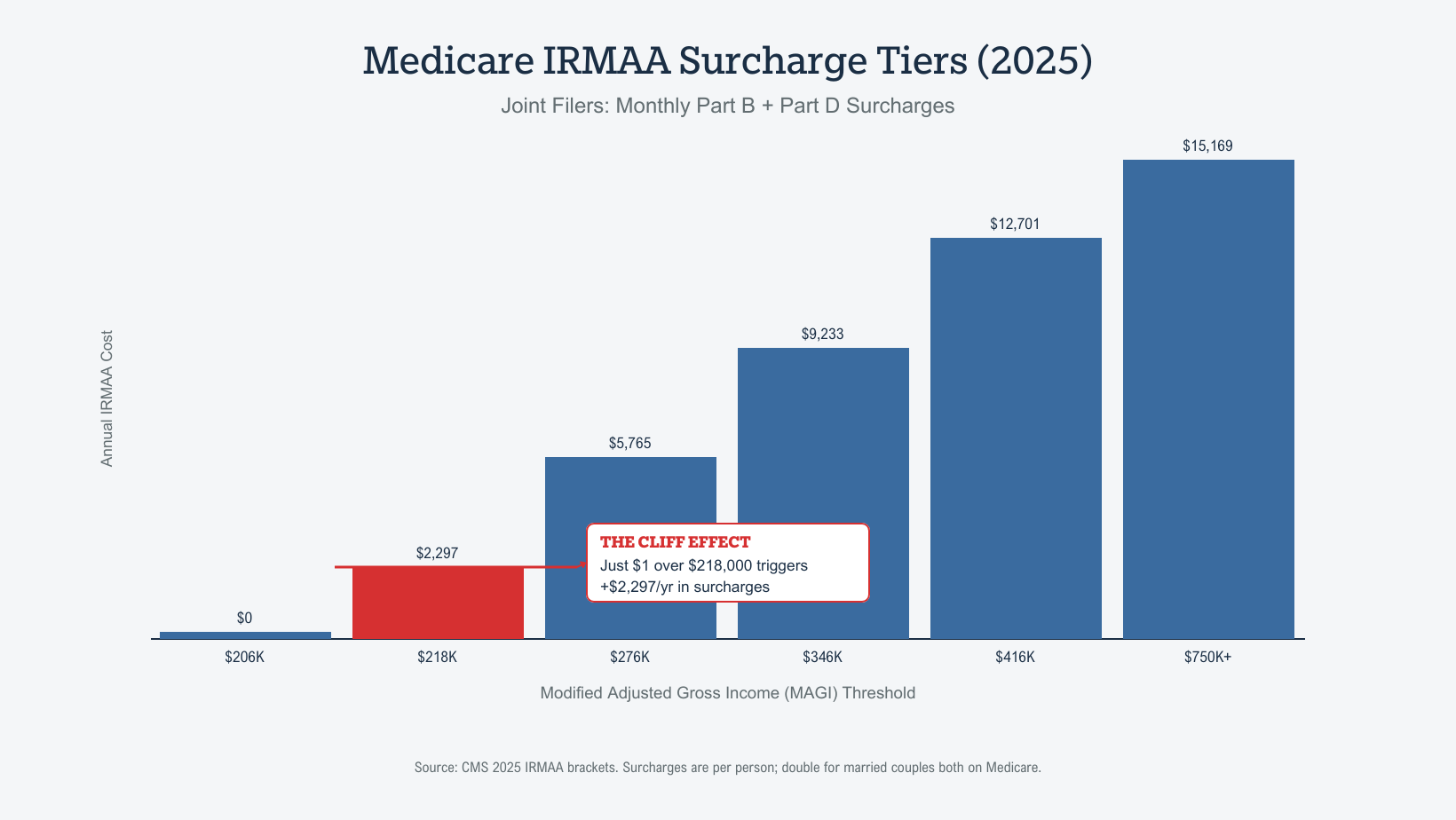
Unlike standard federal income tax brackets—where you only pay the higher rate on the dollars above the line—IRMAA operates on a strict cliff effect. Crossing an IRMAA boundary by even a single dollar triggers the full surcharge for the entire calendar year.
For a married couple in 2026, crossing that $218,000 threshold by one dollar instantly adds over $2,200 in combined annual surcharges to your household healthcare bills.
Is triggering an IRMAA surcharge always a planning failure? Not necessarily.
We may deliberately recommend a conversion that causes a temporary surcharge if the long-term math proves it prevents you from being pushed into even higher tax brackets once Required Minimum Distributions (RMDs) begin later in retirement. The goal is to make sure your healthcare costs are a calculated, strategic choice rather than an accidental tax.
Your final years in the workforce are often your highest-earning years. Severance packages, final corporate bonuses, and pension buyouts can artificially inflate your income right before retirement.
The Win: If your income drops significantly because you retired or reduced your work hours, you do not have to accept the automated premium spike. You can formally appeal the surcharge by submitting Form SSA-44 to the Social Security Administration. This requests a “Life-Changing Event” (LCE) recalculation, forcing the government to adjust your premiums to match your current, lower retirement income instead of your past salary.
If you are preparing to transition from an employer health plan to retirement, call Justin at (269) 323-7964 to run an IRMAA Premium Stress Test and review your local network coverage before you file your next tax return.
Once you hit age 63, your tax return officially becomes a Medicare document due to the government’s strict two-year lookback period. To avoid triggering costly premium surcharges or accidental tax cliffs when you enroll at 65, it is vital to strategically coordinate your corporate bonuses, tax-loss harvesting, and Roth conversions with your future healthcare timelines and Medicare lookback years.


Medicare and You Handbook 2026
Enter your information below to download your 2026 Medicare guide.

Sign up for our monthly newsletter and receive information on retirement strategies, financial planning, Medicare, upcoming workshops, and more.
Enter your information below, and we’ll see you in your inbox soon!