The 2-Year Lookback Zone
Starting at age 63, major financial moves (Roth conversions, real estate sales, corporate exits) directly dictate your Medicare costs at age 65.

How Does Your Income Affect Your Medicare Costs?

“As a fiduciary, my role is to look beyond just your health coverage and analyze how your financial moves—like tax-planning strategies—interact with your Medicare costs. This ‘Medicare-to-Tax’ connection is one of the most overlooked areas of retirement planning.” Justin Henrich, Medicare, Insurance, & Financial Advisor


For most high-net-worth earners, tax planning and healthcare decisions live in completely separate silos. You work with a CPA to minimize your tax brackets and an insurance expert to pick your health plans.
Once you cross into your 60s, your annual federal tax return quietly transforms into a high-stakes Medicare blueprint. If you fail to intentionally coordinate your private portfolio maneuvers, real estate liquidations, or business exit packages with future healthcare timelines, standard financial strategies can backfire and trigger thousands of dollars in hidden surcharges.
Many modern professionals are surprised to learn that their tax-bracket planning directly determines what they pay for health insurance. This relationship is governed by the Income-Related Monthly Adjustment Amount (IRMAA)—a mandatory premium surcharge added directly to standard Medicare Part B and Part D plans if your income crosses specific limits. Healthcare costs do not exist in a vacuum. Every investment selection, capital gain, and tax decision you execute impacts your premium budget.
Medicare evaluates your monthly costs based on your Modified Adjusted Gross Income (MAGI). This evaluation relies on a strict two-year lookback period. Your 2026 Medicare costs are entirely determined by the reported income from your 2024 federal tax returns.
Because of this fixed gap, once you reach age 63, you are officially operating inside the Medicare Lookback Zone. Every major capital gain, distribution, or structural pivot you execute is being monitored by the Social Security Administration to establish your future premium rates.
Unlike progressive federal income tax brackets—where you are only taxed at a higher percentage on the specific dollars that float above a line—the Income-Related Monthly Adjustment Amount (IRMAA) is a strict cliff effect. Stepping over a threshold by a single dollar triggers the mandatory surcharge for the entire calendar year across both Medicare Part B and Part D.
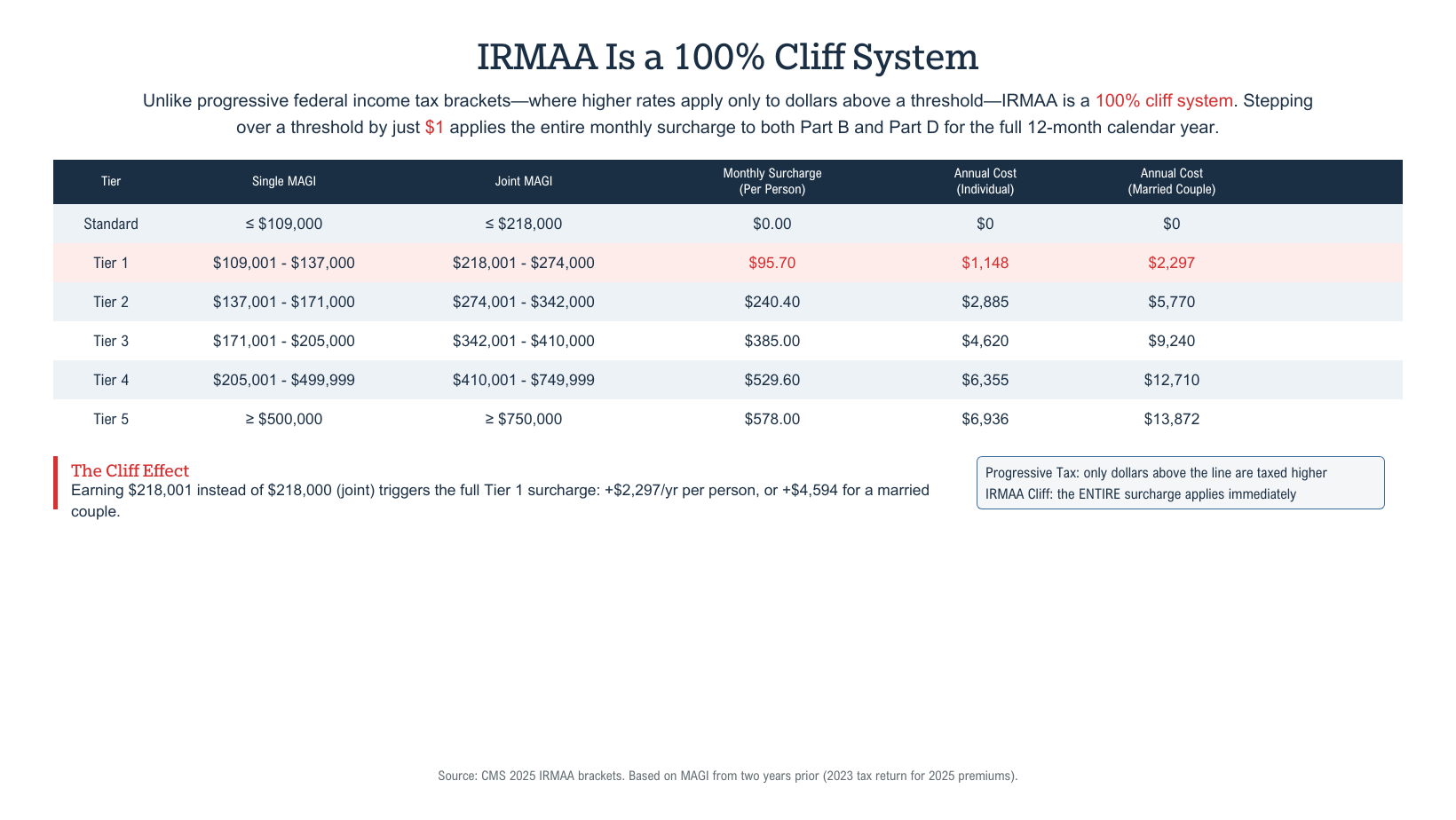
For a high-net-worth household, navigating the multi-tiered baseline limits requires precise execution:
Protecting your nest egg from accidental premium spikes means understanding the hidden income elements that traditional tax strategies overlook:

“This cliff structure is exactly why a single dollar can cost you thousands,” warns Henrich. “Unlike progressive tax brackets where only the excess is taxed at a higher rate, hitting an IRMAA cliff means that crossing the boundary by pocket change triggers the full premium surcharge for the entire year. It transforms a smart tax-saving tool like a Roth conversion into an expensive Medicare mistake if you don’t calculate the exact threshold boundaries.”
Is triggering an upper-tier IRMAA surcharge always a wealth management failure? Not necessarily.
From a fiduciary perspective, we may deliberately recommend an aggressive portfolio move or a major Roth conversion that triggers a temporary one-year surcharge if the long-term math proves it prevents you from being pushed into even higher permanent tax and surcharge brackets once mandatory distributions begin later in retirement. The objective is to ensure your healthcare overhead is a calculated, strategic choice rather than an accidental tax penalty.
If you are inside the Medicare Lookback Zone, we utilize several advanced mechanisms to optimize your income exposure:
 Managing your Modified Adjusted Gross Income (MAGI) requires looking at hidden income streams that standard income tax brackets often completely ignore. When I work with high-net-worth families, we focus heavily on uncovering these overlooked triggers:
You should never let uncoordinated investment moves or a simple timing mistake dictate your household overhead. Before you execute your next tax strategy, execute a business sale, or alter your retirement distributions, let’s look at the complete picture together.
Call Justin directly at (269) 323-7964 to schedule a personalized IRMAA Premium Stress Test. We will look at your lookback years, map out your future healthcare timelines, and ensure your wealth management strategy protects your retirement nest egg from expensive, accidental tax cliffs.
Sources


Medicare and You Handbook 2026
Enter your information below to download your 2026 Medicare guide.

Sign up for our monthly newsletter and receive information on retirement strategies, financial planning, Medicare, upcoming workshops, and more.
Enter your information below, and we’ll see you in your inbox soon!